#ByeFelipe: The Prevalence of Internet Harassment and Misogyny and the Women Combating It
By Delaney Auth
Any woman who spends any time on the Internet, particularly on social networking or dating sites, has likely had some kind of run in with harassment. I myself have been approached by strangers on sites like Facebook and received some serious anger when I tried to politely decline the advances. As women, we face harassment every day, whether it be on the street, at work, in school, and now even online. As the Internet increased in popularity and accessibility, a new platform for harassment has surfaced. Women have been attacked online in recent years for expressing their opinions and beliefs, calling for diversity in the media, turning down a man’s advances, fighting for equality, claiming autonomy over their bodies, and plenty of things that our society feels women should not do. Well, Alexandra Tweten, creator of the Instagram account @byefelipe, is as fed up with the tolerance of this abhorrent behavior by a certain group of men online as we are.
Tweten created the account @byefelipe in response to seeing a screenshot of a conversation a woman had with a man on a dating site. She compared the incident to a similar encounter she’d had and decided to look into it. This eventually became #ByeFelipe. Tweten finds screenshots online of troubling encounters women have had online with men whose advances they have rejected and posts them to the Instagram account captioned with a brief explanation and #byefelipe. Why the name Felipe? It’s a play on the meme Bye Felicia, which is described by Urban Dictionary as a response when a girl tells you she’s leaving and you don’t care enough to use her name. Tweten uses Felipe to flip it around and tell a man who gets rude and offensive when rejected that, due to his response, he (and his opinion of the woman) no longer matters. Many of the messages the women receive are completely absurd. Some are threatening, some just extremely insulting, but they are all harassment. Sometimes the men are politely rejected by women but a considerable number also respond appallingly in situations where a woman doesn’t answer quickly enough or misses the initial message. Either way the clear issue is this sense of entitlement some men seem to have when it comes to the attention of women they find attractive. Here’s a couple examples from @byefelipe. 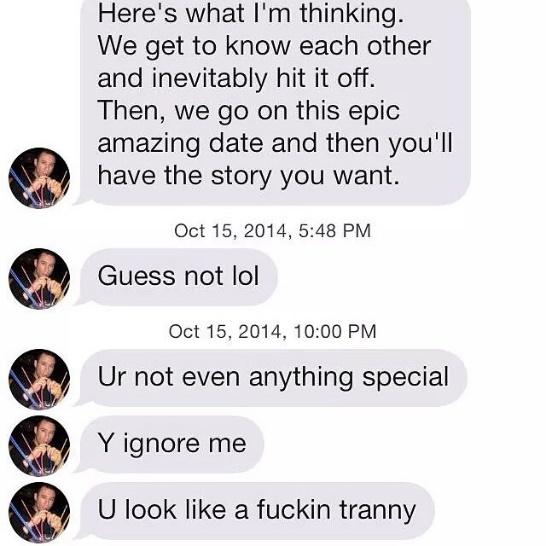
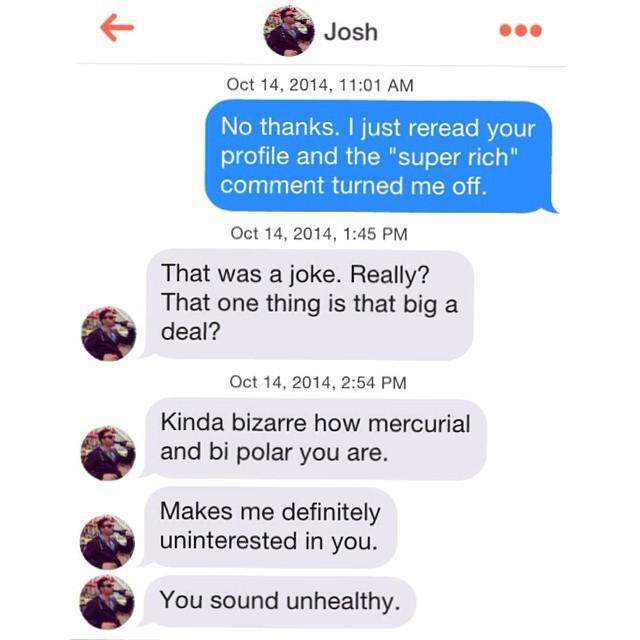

These are pretty appalling, and the idea that men are somehow entitled to the attention of the women they find sexually attractive is ludicrous. @ByeFelipe has definitely been a wonderful medium to get a conversation started about online harassment. Tweten is not the only one trying to call attention to this issue, however. A woman named Laura Nowak from Toronto, Ontario decided to conduct a Tinder experiment in which she tried to start conversations with men she matched with about feminism. While many of the men were receptive and participated in very constructive discussions of the topic, there were also many that resorted to harassment when they realized she wasn’t looking to have casual sex with them. She was called unpleasant names, ridiculed for her beliefs, confronted by rape apologists, and much more. Her experiment came to the conclusion that while about a third of the men she talked to were respectful and open to having a discussion about feminism, the other two-thirds or so were rude, threatening, and openly misogynistic. When they realized that the woman they were talking to wasn’t interested in having sex with them, they often resorted to cruelty. Here’s a couple screenshots from Nowak’s experiment…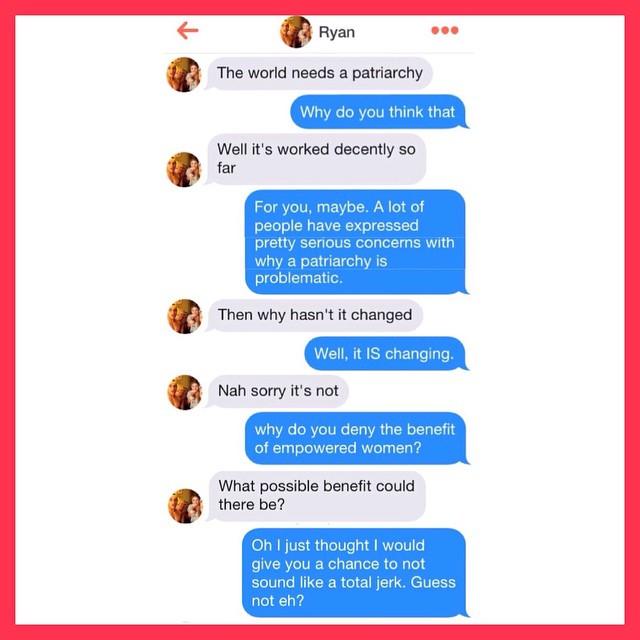

There are more on her Instagram account, @feministsontinder, including conversations where men tell her she looks “rapeable”, defend rape as an evolutionary reproductive instinct, and imply that women who go out on dates owe that man sex, along with plenty of other disgusting and inappropriate messages. Like Tweten, Nowak uses Instagram to put these pieces of human trash out in the open and make people aware of the issues with the way a lot of men choose to treat women online. However, Nowak also posts the productive, intellectual, and respectful discussions she has with men who are open to the idea of feminism, which can be refreshing after reading some of the messages she gets from the misogynists.
Women face all kinds of different forms of harassment from men online in many different forums. In August of 2014, hundreds of celebrities with the victims of a photo hack that shared their private photos with the public. Links to the photos of celebrities like Jennifer Lawrence, Aubrey Plaza, Ariana Grande, Victoria Justice, Kate Upton, Kirsten Dunst, and many, many others were posted without their consent on Reddit and 4chan. The online backlash when people spoke out against the sharing and viewing of these photos was astounding. Many men claimed that they were within their right to free speech or some such nonsense to post and view the photos and erupted in outrage as sites banned the photos. Emma Watson tweeted that she was disgusted with the invasion of privacy and became a target of threats and harassment, with people posting that they hoped she was next to have her privacy invaded and threatening to find and leak photos of her out of spite. Many men online argued that the women should be proud that their bodies were found sexually attractive, while totally ignoring the fact that these women had been violated and disrespected. Then, in an effort to thwart those who were angry about distribution of the pictures, a group started donating money to The Prostate Cancer Research Fund and Water.org every time the photos were viewed. The donation page was titled “The Fappening” and attacked the morality of people opposing the viewing and sharing of the pictures because they were “donating money to a good cause”. Both organizations refused to take any of the money donated by the page. The idea that violating a woman’s privacy is okay as long as you also donate money to charity is first of all, ridiculous, and second of all, an endorsement of rape culture. Many women who spoke out against the leak were ridiculed, harassed, and threatened on social media, and men who spoke out were mocked and sarcastically referred to as “white knights”. The illegally obtained photos were banned and eventually mostly removed from the web, but the idea that the women deserved to have their private photos shared with the world because they had chosen to share them with one or a few intimate partners still pervades our society, and is indicative of a culture that does not value the concept of consent the way it should.
The last few months have also seen the Gamergate debacle, in which women in video game industry were made the targets of extreme sexism and misogyny. Female gamers, game developers, and other women in the industry, were threatened, harassed, and belittled on sites like Twitter and Reddit, because they called for more diversity and representation in video game culture. Men who stood up for these women were again mockingly referred to as “white knights” and “social justice warriors”. Anita Sarkeesian, a feminist blogger and media critic, received so many death threats that she was forced to leave her home temporarily after someone leaked her home address to the public. Game developers Zoe Quinn and Brianna Wu were also main targets for threats and harassment. Eventually, other prominent members of the industry helped to speak out against the harassment and the situation died down, however, sexism is still a major issue for women who participate in geek/nerd culture.
A more recent development online is the so-called “meninist” movement. This is a Twitter movement (mostly) that opposes feminism and claims to fight male, particularly white male, oppression. Unfortunately, “meninists” seem to be dedicating their lives to missing the point of modern feminism. Many of the issues they try to tackle are things that feminist ideology recognize as equality issues because they stem from the patriarchy, such as our society’s outdated ideas of what masculinity and toughness should look like in a man. “Meninists” don’t see that this issue and other related issues are something that feminism also tries to combat and their “movement” focuses mostly on harassing feminists online anyway. I have witnessed “meninists” on Twitter arguing that women are responsible for their own rape, threatening feminists with rape, denying the existence of the wage gap, mocking women for their appearance, claiming women “belong in the kitchen”, and expressing many, many other damaging and disgusting ideas. It is clearly a platform with which to mock and harass those who fight for equality, not an actual movement to achieve social justice. “Meninism” is just yet another form of online harassment that women face daily.
The rise of technology has resulted in a world where people can say almost whatever they want on the Internet and face little or no consequences. This environment has had negative effects that we as a society choose to recognize, like general cyber-bullying but it has also allowed for a more specific type of harassment that we don’t like to think about as much. The harassment that women face online needs to be exposed. Hopefully, women like Alexandra Tweten and Laura Nowak will continue to step up and expose this horrible manifestation of blatant misogyny so that we can hold those that participate in it accountable and do our best to eradicate harassment of any kind.
