Showing posts with label Delaney Auth. Show all posts

Wednesday, March 4, 2015

Why We SHOULD Be Casting More Actors of Color in Superhero Movies By Delaney Auth

Why We SHOULD Be Casting More Actors of Color in Superhero Movies
By Delaney Auth
Michelle Rodriguez caused a lot of conversation with her controversial remarks about the rumors that she had been cast to play Green Lantern in the DC cinematic universe, saying that, “Stop stealing white people’s superheroes. Like, make up your own, you know what I’m saying?” Rodriguez later apologized for the comment, saying that she only meant she thought the community would benefit from creating new heroes for actors of color. While I believe that she meant well, the Internet has exploded into arguments of whether people of color should be cast as traditionally white superheroes. Many in the past and present have reacted with rage to casting decisions that they don’t agree with based on the race of the actor in most genres at one time or another, and comic book inspired films have been no different. It’s true that there is very little diversity in the comic book hero films we have now and the casting of actors of color in upcoming films has caused a level of uproar among a section of the fan base. Rodriguez’s comments may have been well intentioned, but many of the reactions of those that claimed to agree with her were not. As a fan of superhero films inspired by comic books, I have a few reasons that these attitudes toward more diverse casting are troubling.
First of all the idea that actors of color are “stealing” roles from white actors is ridiculous. We still don’t have a mainstream comic book hero movie with a person of color as the leading hero. There are a couple in the works, but it’s not like there’s a history of casting directors giving superhero roles to people who are not white. The Avengers are all white. Batman in Christopher Nolan’s Dark Knight trilogy is white. Spiderman (whether you prefer Tobey Maguire or Andrew Garfield) is white. Man of Steel’s Superman is white. Guardians of the Galaxy featured a more diverse cast, but the leading man was still a white guy. Hell, even Green Lantern, who is often portrayed as a black man in the comics, was played by a white actor. Not to say that we should never cast white men as superheroes; they deserve to be considered for those roles as well. But it’s not a bad thing to see some more diversity in the genre. And we’re (hopefully) on our way.
As Warner Brothers has begun casting for their darker, edgier imagining of the Justice League they’ve made some unconventional casting decisions. Hawaiian actor Jason Momoa has been cast as Aquaman and the first released photo shows him holding a formidable trident and sporting some Polynesian inspired tattoos. Israeli model and actress Gal Gadot has also been cast for the franchise, as Wonder Woman, adding a touch more cultural diversity to the cast. Both Momoa and Gadot will be featured in Batman vs Superman: Dawn of Justice and an untitled Justice League film. They will also each get at least one solo film for their respective characters. Marvel has announced Black Panther, a movie inspired by comics featuring an African prince as the title character. Chadwick Boseman has been cast as the lead. It’s slated to come out in 2018. The casting of African American actor Michael B. Jordan in the newest adaptation of The Fantastic Four as Johnny Storm, aka Human Torch, added diversity to that franchise and ignited anger from some fans (the character is traditionally white). These films are a good start, but there’s still a ways to go for diversity in the genre and there’s still a lot of resistance to more diverse casting. I would say that actors of color are obviously quite far from “stealing white people’s superheroes.”
The other issue I have with the resistance to making more diverse casting decisions has to do with the nature of comic books. Comic book heroes exist in a whole host of different universes. The genre has been ever-changing. I mean come on, people, in the most recent editions of Marvel’s comics Captain America is black and Thor is a woman. Making movie adaptations can be really difficult because of how much different literature there can be for just one character. Most heroes exist in multiple, unrelated universes. Their costumes, love interests, enemies, allies, and backstories often vary at least slightly from universe to universe. In a community with as much literature as the comic book community, it can be tricky to get nitpicky with movie adaptations. For these reasons, in most circumstances fans are willing to cut filmmakers a little slack. A segment of the fan base has not been willingly to do the same when it comes to the race of the actors portraying the character. There are a few characters whose racial backgrounds vary in many their different universes. Green Lantern, Iron Man, and Spiderman have all been black at various times in some of their comic book universes, but you don’t hear the people who complain about casting of Human Torch or Aquaman also arguing that they could have cast black actors in place of Ryan Reynolds or Robert Downey Jr. In fact, when rumors that Donald Glover was being looked at to play Spiderman in a new Spiderman franchise tentatively titled, The Spectacular Spiderman, parts of the fan community expressed their extreme displeasure with the idea of a black Spiderman. There is a comic universe in which Miles Morales, a character of Black Hispanic descent, takes over as Spiderman, but this fact didn’t seem to calm the outrage of certain parts of the fan base. However, while the Donald Glover rumors probably aren’t true, Marvel has implied that they will mostly cast an actor who is not white in the role, so fans may have to get used to the idea of a black or Latino (or maybe even both) Spiderman.
This kind of blind (and, I’m sorry, childish) rage over the color of fictional people, who are at times depicted in the source material as a people of color anyway, persists in spite of the facts and proves that the issue isn’t really whether or not the director is being true to the original art. We saw it when there were rumors that Idris Elba would be the next James Bond. It was an issue when Lenny Kravitz, Amandla Stenburg, and Dayo Okeniyi were cast in The Hunger Games, even though both Rue (Stenberg) and Thresh (Okeniyi) were definitely described in the books as having dark skin (Apparently Cinna’s complexion is never described, although I remember picturing him as a POC while reading the series). People throw fits about casting whether there is or isn’t a basis in the source material for the assumption that the character is white. Because guess what? It’s not about the source material. It’s not about staying true to the original art. It’s about the attitudes about race that pervade our country and have done so for the entirety of our history. It’s because of the (sometimes) unconscious racism that privileged groups have been taught to ignore, ignore, ignore, and that causes the completely ridiculous and false idea that white people will, for some reason, not be able to relate to a hero of color. Your inability to relate to a human whose skin is a few shades darker than yours doesn’t determine what career opportunities that person should have. People of color aren’t “stealing” superheroes away from white people. Some people, however, seem intent on limiting opportunities for people of color and that is what I find unacceptable.

Sunday, March 1, 2015

The Experience of a Female Sports Fan: Harassment and Disrespect in the Mainstream Sports Community By: Delaney Auth

The Experience of a Female Sports Fan: Harassment and Disrespect in the Mainstream Sports Community
By: Delaney Auth
I’ve been a sports fan for about as long as I can remember. Sports are a way that my family can spend time together and bond and has been for my entire life. My dad’s side of the family is from Pittsburgh so we were all raised to worship former Steelers owner Art Rooney as next to a god. For whatever reason, as we got older it became clear that my step-sister and I were the big sports fans, while my brother generally couldn't care less. We particularly loved hockey and football, and from a pretty young age jumped into learning as much as we could about the teams we rooted for, both past and present. We knew the current players, coaches, and owners as well as most of the ones from past years. We were able to rattle off the statistics of our favorites, to argue about controversial calls by the refs, and understood the rules and strategies of the game.
It didn’t take long for me to understand that a lot of sports fans did not take me seriously because I was a girl. When the Steelers went to the Super Bowl in the 2008-2009 season I was in 7th grade and a fellow classmate heard me talking excitedly about my team, laughed, and told me that he doubted I could name five Steelers players. I responded by naming about ten to fifteen before he rolled his eyes at me and cut me off. It has not stopped since then. Male sports fans have laughed at me, quizzed me on team trivia, called me names like “puckslut”, harassed me at games, and much, much more. My experience is not uncommon, in fact I think you’d be hard pressed to find a single female sports fan who hasn’t experienced some kind of harassment, disrespect or disdain.
One of the main forms that this kind of behavior takes is through assumptions about the “real” reasons that women want to watch sports. The most common that I’ve heard over the years are the idea that women watch sports to impress men, or women only watch sports because they think the players of a particular sport are hot. The latter is particularly common in the hockey fan community, and usually expressed with the term I previously mentioned: “puckslut”. Now there a lot of issues with that word and the attitudes surrounding it. First of all, who cares why a woman wants to watch sports? That is her decision and none of anyone else’s business. Second of all, there is no reason to assume what a person’s reasons are for liking a thing and even less reason to say they’re lying when they correct you. The word “puckslut” and the shaming that comes with it is just another form of slut shaming. And slut shaming is not okay.
There is also an element of sexual harassment that is inevitably faced by women who participate in the mainstream sports communities. I have been jeered at leaving games by drunken men leaning out of bars since I was thirteen. As a Pittsburgh fan living in Central Illinois, most of the games we attend are away games for our teams. We went to a whole lot of Pirates games when they would play the Cubs in Chicago and so there was a lot of well-meaning teasing that you would get, especially if the Pirates lost. Some of it was not so harmless. I remember at one game when I was about thirteen or fourteen, one of the men sitting behind us was taunting and razzing us through the game. He strayed from baseball and began to focus on football. It was around the time that the rape allegations against Ben Roethlisberger had come out, and this man decided to yell, “I’ll bet he’d rape you, too,” at my step-sister and I, laughing. My parents were furious, and something my dad said to him shut him up for the rest of the game, although I’m not sure what it was. It was inappropriate, disgusting, and like all rape jokes, not funny.
This kind of harassment is unfortunately extremely common within mainstream sports. Certain male fans of the New York Jets made a habit of gathering at Gate D of their stadium, shouting obscenities at women as they passed by and demanding that they flash their breasts. At one particular game in 2007, a woman who refused was bombarded with beer bottles and garbage, and even spit on. Female sports announcers and reporters don’t escape this treatment. Sports reporter Erin Andrews, is talked about for her looks more often than for how good she is at her job and she has even been stalked at her hotel. Women with jobs in the industry are often stalked and harassed online for unpopular opinions, or for criticizing male players, officials, or administration. Female commentators like Samantha Ponder and Michelle Beadle were attacked and threatened online for speaking out about the NFL’s handling of the domestic violence allegations and evidence against Ray Rice. The pattern of sexual harassment in the sports fan community is persistent and disgusting. Women should be able to feel comfortable and safe as fans or industry employees.
I’m tired of all of this and more. I’m tired of feeling uncomfortable and sometimes unsafe at games or in sports bars. I’m tired of sports organizations like the NFL not taking domestic violence, rape, and sexual harassment seriously when it is perpetrated by players and other members of their community and organization. I’m exhausted with having to play sports trivia with men every time I mention that I am a sports fan. I’m so done with men thinking it’s okay to ask me if I’m a “real fan” or “just some puckslut”, like it matters. Women cannot be casual sports fans in the way that men can, we have to know everything there is to know or we’re just some silly girl doing it for the attention. This kind of behavior is unacceptable and as long as sports organizations allow it to go on without even acknowledging it, it will persist.
The organizations and the fans who behave this way must be held accountable for their actions. Until they are, being a sports fan will continue to be challenging, and at times dangerous for women. We shouldn’t allow our society to tell us what we can and can’t like and how much we should or shouldn’t like it. Sports are supposed to be fun. It is just a game after all.

Monday, February 9, 2015

#ByeFelipe: The Prevalence of Internet Harassment and Misogyny and the Women Combating It By Delaney Auth

#ByeFelipe: The Prevalence of Internet Harassment and Misogyny and the Women Combating It
By Delaney Auth
Any woman who spends any time on the Internet, particularly on social networking or dating sites, has likely had some kind of run in with harassment. I myself have been approached by strangers on sites like Facebook and received some serious anger when I tried to politely decline the advances. As women, we face harassment every day, whether it be on the street, at work, in school, and now even online. As the Internet increased in popularity and accessibility, a new platform for harassment has surfaced. Women have been attacked online in recent years for expressing their opinions and beliefs, calling for diversity in the media, turning down a man’s advances, fighting for equality, claiming autonomy over their bodies, and plenty of things that our society feels women should not do. Well, Alexandra Tweten, creator of the Instagram account @byefelipe, is as fed up with the tolerance of this abhorrent behavior by a certain group of men online as we are.
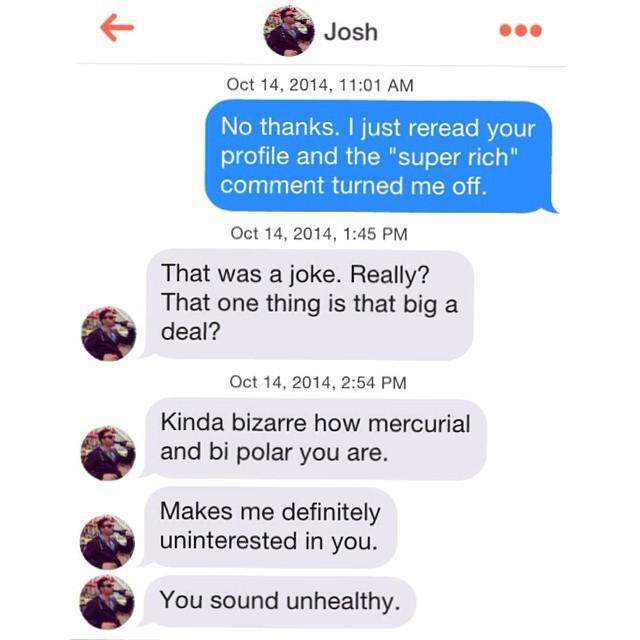
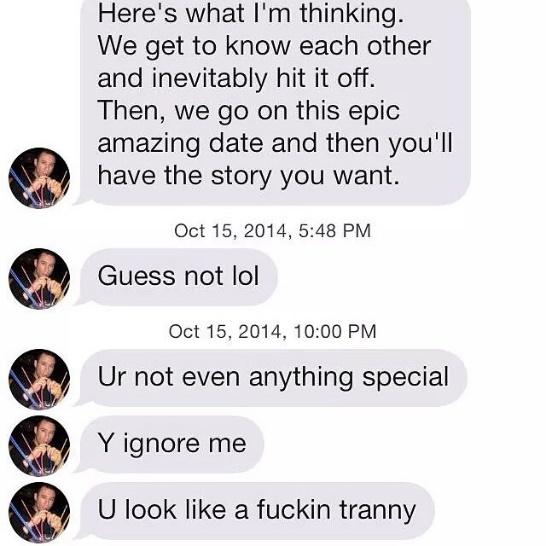
Tweten created the account @byefelipe in response to seeing a screenshot of a conversation a woman had with a man on a dating site. She compared the incident to a similar encounter she’d had and decided to look into it. This eventually became #ByeFelipe. Tweten finds screenshots online of troubling encounters women have had online with men whose advances they have rejected and posts them to the Instagram account captioned with a brief explanation and #byefelipe. Why the name Felipe? It’s a play on the meme Bye Felicia, which is described by Urban Dictionary as a response when a girl tells you she’s leaving and you don’t care enough to use her name. Tweten uses Felipe to flip it around and tell a man who gets rude and offensive when rejected that, due to his response, he (and his opinion of the woman) no longer matters. Many of the messages the women receive are completely absurd. Some are threatening, some just extremely insulting, but they are all harassment. Sometimes the men are politely rejected by women but a considerable number also respond appallingly in situations where a woman doesn’t answer quickly enough or misses the initial message. Either way the clear issue is this sense of entitlement some men seem to have when it comes to the attention of women they find attractive. Here’s a couple examples from @byefelipe.
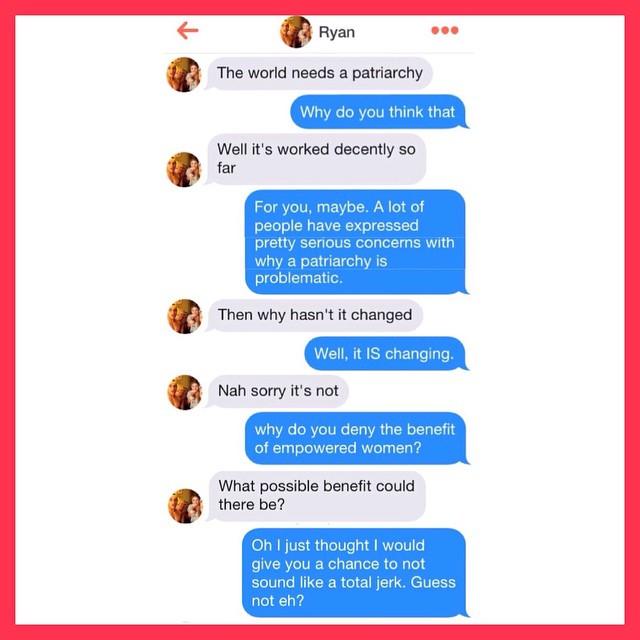
These are pretty appalling, and the idea that men are somehow entitled to the attention of the women they find sexually attractive is ludicrous. @ByeFelipe has definitely been a wonderful medium to get a conversation started about online harassment. Tweten is not the only one trying to call attention to this issue, however. A woman named Laura Nowak from Toronto, Ontario decided to conduct a Tinder experiment in which she tried to start conversations with men she matched with about feminism. While many of the men were receptive and participated in very constructive discussions of the topic, there were also many that resorted to harassment when they realized she wasn’t looking to have casual sex with them. She was called unpleasant names, ridiculed for her beliefs, confronted by rape apologists, and much more. Her experiment came to the conclusion that while about a third of the men she talked to were respectful and open to having a discussion about feminism, the other two-thirds or so were rude, threatening, and openly misogynistic. When they realized that the woman they were talking to wasn’t interested in having sex with them, they often resorted to cruelty. Here’s a couple screenshots from Nowak’s experiment…
There are more on her Instagram account, @feministsontinder, including conversations where men tell her she looks “rapeable”, defend rape as an evolutionary reproductive instinct, and imply that women who go out on dates owe that man sex, along with plenty of other disgusting and inappropriate messages. Like Tweten, Nowak uses Instagram to put these pieces of human trash out in the open and make people aware of the issues with the way a lot of men choose to treat women online. However, Nowak also posts the productive, intellectual, and respectful discussions she has with men who are open to the idea of feminism, which can be refreshing after reading some of the messages she gets from the misogynists.

Women face all kinds of different forms of harassment from men online in many different forums. In August of 2014, hundreds of celebrities with the victims of a photo hack that shared their private photos with the public. Links to the photos of celebrities like Jennifer Lawrence, Aubrey Plaza, Ariana Grande, Victoria Justice, Kate Upton, Kirsten Dunst, and many, many others were posted without their consent on Reddit and 4chan. The online backlash when people spoke out against the sharing and viewing of these photos was astounding. Many men claimed that they were within their right to free speech or some such nonsense to post and view the photos and erupted in outrage as sites banned the photos. Emma Watson tweeted that she was disgusted with the invasion of privacy and became a target of threats and harassment, with people posting that they hoped she was next to have her privacy invaded and threatening to find and leak photos of her out of spite. Many men online argued that the women should be proud that their bodies were found sexually attractive, while totally ignoring the fact that these women had been violated and disrespected. Then, in an effort to thwart those who were angry about distribution of the pictures, a group started donating money to The Prostate Cancer Research Fund and Water.org every time the photos were viewed. The donation page was titled “The Fappening” and attacked the morality of people opposing the viewing and sharing of the pictures because they were “donating money to a good cause”. Both organizations refused to take any of the money donated by the page. The idea that violating a woman’s privacy is okay as long as you also donate money to charity is first of all, ridiculous, and second of all, an endorsement of rape culture. Many women who spoke out against the leak were ridiculed, harassed, and threatened on social media, and men who spoke out were mocked and sarcastically referred to as “white knights”. The illegally obtained photos were banned and eventually mostly removed from the web, but the idea that the women deserved to have their private photos shared with the world because they had chosen to share them with one or a few intimate partners still pervades our society, and is indicative of a culture that does not value the concept of consent the way it should.
The last few months have also seen the Gamergate debacle, in which women in video game industry were made the targets of extreme sexism and misogyny. Female gamers, game developers, and other women in the industry, were threatened, harassed, and belittled on sites like Twitter and Reddit, because they called for more diversity and representation in video game culture. Men who stood up for these women were again mockingly referred to as “white knights” and “social justice warriors”. Anita Sarkeesian, a feminist blogger and media critic, received so many death threats that she was forced to leave her home temporarily after someone leaked her home address to the public. Game developers Zoe Quinn and Brianna Wu were also main targets for threats and harassment. Eventually, other prominent members of the industry helped to speak out against the harassment and the situation died down, however, sexism is still a major issue for women who participate in geek/nerd culture.
A more recent development online is the so-called “meninist” movement. This is a Twitter movement (mostly) that opposes feminism and claims to fight male, particularly white male, oppression. Unfortunately, “meninists” seem to be dedicating their lives to missing the point of modern feminism. Many of the issues they try to tackle are things that feminist ideology recognize as equality issues because they stem from the patriarchy, such as our society’s outdated ideas of what masculinity and toughness should look like in a man. “Meninists” don’t see that this issue and other related issues are something that feminism also tries to combat and their “movement” focuses mostly on harassing feminists online anyway. I have witnessed “meninists” on Twitter arguing that women are responsible for their own rape, threatening feminists with rape, denying the existence of the wage gap, mocking women for their appearance, claiming women “belong in the kitchen”, and expressing many, many other damaging and disgusting ideas. It is clearly a platform with which to mock and harass those who fight for equality, not an actual movement to achieve social justice. “Meninism” is just yet another form of online harassment that women face daily.
The rise of technology has resulted in a world where people can say almost whatever they want on the Internet and face little or no consequences. This environment has had negative effects that we as a society choose to recognize, like general cyber-bullying but it has also allowed for a more specific type of harassment that we don’t like to think about as much. The harassment that women face online needs to be exposed. Hopefully, women like Alexandra Tweten and Laura Nowak will continue to step up and expose this horrible manifestation of blatant misogyny so that we can hold those that participate in it accountable and do our best to eradicate harassment of any kind.

Monday, November 3, 2014

The Rise of the Female Pop Star in 2014 By: Delaney Auth


It’s Been a Pretty Great Year For Female Pop Artists
By: Delaney Auth

            There’s a pretty stark difference in the Billboard Charts from last year to now. The charts for 2014 have been packed with the songs of female pop artists, which is a lot different than it was only a year ago. According to Billboard the top 10 songs from the whole year of 2013 looked like this:
1)      Blurred Lines by Robin Thicke feat. T.I. and Pharrell
2)      Locked Out Of Heaven by Bruno Mars
3)      I Knew You Were Trouble by Taylor Swift
4)      Can’t Hold Us by Macklemore and Ryan Lewis feat. Ray Dalton
5)      Clarity by Zedd feat. Foxes
6)      Mirrors by Justin Timberlake
7)      Radioactive by Imagine Dragons
8)      Don’t You Worry Child by Swedish House Mafia feat. John Martin
9)      Thrift Shop by Macklemore and Ryan Lewis feat. Wanz
10)  Daylight by Maroon 5
Now, while most of these are pretty great songs (I say most because of the obvious issues with number one. Robin Thicke can go.), there is so little representation of female artists here. Only Taylor Swift and Foxes made it to the top ten and only Swift’s single is solo. As if women’s representation wasn’t rough enough, the number one spot is taken by a sexist song with a catchy beat that treats women as nothing more than voiceless sex objects. Ugh. The most recent top ten list from this year, however, is looking a whole lot better for our most loved female pop stars. Here’s the most recent Billboard top ten.
1)      All About That Bass by Meghan Trainor
2)      Shake It Off by Taylor Swift
3)      Habits by Tove Lo
4)      Bang Bang by Jessie J, Ariana Grande, and Nicki Minaj
5)      Animals by Maroon 5
6)      Black Widow by Iggy Azalea feat. Rita Ora
7)      Don’t Tell ‘Em by Jeremih feat. YG
8)      Hot Boy by Bobby Schmurda
9)      Take Me To Church by Hozier
10)  Stay With Me by Sam Smith
This week’s top ten is half women. And for the most part, the singles these female artists got onto the list are feel good songs focused on empowerment. Taylor Swift’s “Shake It Off” is all about dismissing the haters and just doing you, “Bang Bang” expresses female sexuality in a healthy fashion, along with being catchy and wonderful, and with “Black Widow” Iggy and Rita drive home the point that you had better watch who you mess with. While there are definitely many valid feminist complaints concerning Meghan Trainor’s All About That Bass, it’s certainly new to hear a song about girls with curvy bodies occupying the top slot. But this is only the top ten from this week and female artists have been killing it all year. Iggy Azalea and Charli XCX dominated with “Fancy”, Charli XCX’s song “Boom Clap” occupied top ten charts for a few weeks, and Nicki Minaj expressed her sexuality quite openly with “Anaconda”. Ariana Grande encouraged her audiences to ditch that lying ex with “Break Free” and her single “Problem” featuring Iggy Azalea took over the radio for weeks. Katy Perry, Lorde, Rihanna, Shakira, Jennifer Lopez and many more fantastic ladies of pop had their moments to slay this year. Even female cartoon characters got their songs played. Frozen’s “Let It Go” was a huge hit and won the Academy Award for best original song. If we’re talking albums, Taylor Swift’s album 1989, which was released October 28th, is estimated to sell 1.1 million copies by the end of it’s first week alone, which would make it the first platinum album released this year, as well as the first album to go platinum in a week since Swift’s last album, Red. Ariana Grande’s My Everything has been a success for her, snatching up the number one slot the week it was released with 138,000 copies sold in just the first seven days. Iggy Azalea’s The New Classic was also a hit, selling over 52,000 copies in the first week as well as landing the number 3 spot on the Billboard Hot 200. It is the highest charting album by a female rapper since Nicki Minaj’s Pink Friday: Roman Reloaded released in 2012. Speaking of Nicki, she has dropped the first hints about her own upcoming album, which, judging by the success of Anaconda, is sure to be big seller.
And I promise all of you I didn’t forget the Queen of the Music Industry, just saved her for last. All hail the mighty Beyoncé, who was awarded the Video Vanguard Award at the 2014 MTV Video Music Awards, after a spectacularly mind-blowing performance of a medley of the songs from her most recent album, Beyoncé, during which she stood proudly in the middle of the stage as the word “FEMINIST” flashed up behind her in glorious white. While, technically the album was released in December of 2013, we have most definitely felt its influence this year. The songs “Drunk in Love” featuring her husband, Jay-Z, “Pretty Hurts”, “Partition”, and, of course, “***Flawless”, which featured a clip from a Ted Talk given by the Nigerian feminist author Chimamanda Ngozi Adichie, along with the other songs from Beyoncé, became almost immediate hits, which will almost certainly be recognized as classics of our time. Her tour with her husband Jay-Z, On the Run, was given an HBO special. The tour grossed $100 million for the first nineteen shows alone. The North American leg of the tour sold 850,000 tickets, while the two shows in Paris sold 90,000 tickets within two hours of the tickets going on sale.
 Clearly, it’s been a fantastic year for the women of pop music. And, while this is only one year, it’s definitely setting the tone for good years to come. Just keep supporting the female artists you love, in all genres of music and forms of art! Then we’ll get to see more great years like this!